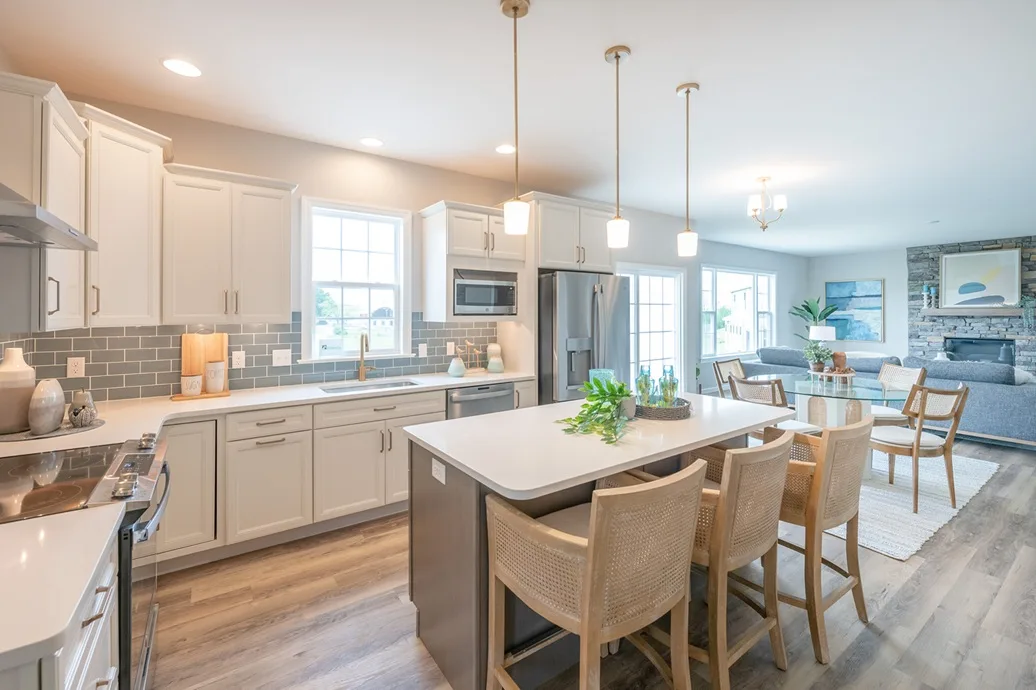
When you’re comparing a new construction home to a resale home, the purchase price is only half the story. Additional costs can live inside the walls of a resale listing, and end up costing you significantly more than your monthly mortgage payment.
Key Takeaways
In this article, you’ll learn:
- Why resale homes often carry energy costs that don’t appear on the listing price
- How EGStoltzfus builds a continuous, verified thermal system from the foundation up
- What a HERS score is and how EGS homes compare to resale and code-minimum construction
- How features like Superior Walls foundations, continuous exterior insulation, and high-efficiency HVAC systems work together to lower monthly utility bills
- What EGS homeowners can save annually, and what that adds up to over time
What a Listing Sheet Might Not Tell You
Many homebuyers have been in this situation – they tour a resale home that just hit the market, and:
The listing price is lower than new home construction.
The neighborhood is established, and the landscaping is already in.
It feels like the practical choice.
But here’s what that math usually leaves out:
The cost to heat and cool the home.
The air that slips through decades-old wall assemblies, door thresholds, and around window frames.
The furnace working overtime to compensate for inadequate insulation.
The hidden costs of buying a resale home don’t show up on the listing sheet, but they do show up every month on your utility bill.
A new construction home isn’t just newer. It’s built differently, from the ground up, as a cost-saving energy system.
What Most Resale Homes are Missing
Many resale homes have never been energy tested. There is no HERS score (more on that below) and no independent verification of the performance taking place inside the walls.
Older homes were built to the energy codes of their era. In other words, they aren’t built to today’s standards.
Insulation was likely added where it was convenient, and foundations were poured in the field under varying conditions. Air sealing was an afterthought if it was thought of at all.
None of these scenarios are visible during a showing, and oftentimes the issues won’t surface in a standard home inspection.
But when a homebuyer purchases new construction, what’s inside the walls is a documented, verified part of what you’re buying.
Starting on Solid Ground: Superior Walls
Most people don’t think about their basement when they think about energy efficiency, but they should.
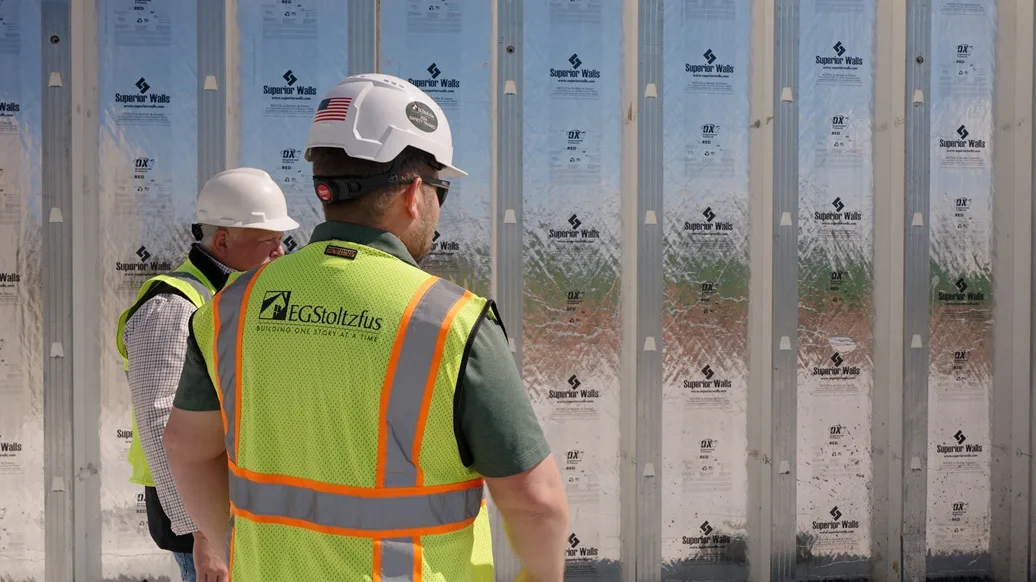
EGStoltzfus homes are built with Superior Walls, a precast concrete foundation system that’s engineered in a controlled environment, which is unlike a conventional poured concrete or block basement.
Superior Walls panels are manufactured in a factory setting using high-strength precast concrete with built-in insulation and steel reinforcement.
Because each panel is produced indoors and delivered to the homesite ready to install, the process eliminates variables that can affect conventional poured concrete foundations – like inconsistent curing conditions, temperature fluctuations, and moisture exposure during the pour.
What are the Benefits of a Superior Walls Basement Assembly?
A Superior Walls basement assembly is one of the first places EGStoltzfus homes start outperforming resale – below grade and before a single stud goes up.
Here are some of the top benefits:
- Built-in insulation and a continous thermal barrier from day one
- Consistent strength and straighter walls
- Faster installation than conventional methods
- Superior moisture control and reduced risk of water intrustion
- Immediate readiness for basement finishing – no retrofitting needed
Continuous Exterior Insulation
When looking at insulation, the number that gets the most attention is the R-value. It’s a measure of thermal resistance, or how well a material slows the transfer of heat.
The higher the R-value, the greater the resistance. But the R-value alone doesn’t tell the whole story of how a home actually performs.
Here’s why:
Traditional 2×6 walls with R-19 batt insulation have a higher stated R-value than a 2×4 wall with R-13 insulation. But batt insulation is interrupted by studs, and energy can escape through the framing. The real-world performance can drop below what the spec sheet says.
EGStoltzfus uses a 2×4 wall system spaced at 16” with R-13 insulation plus R-5 continuous exterior insulation. That continuous layer is installed on all exterior thermo-envelope framed walls to create an unbroken thermal barrier. The result is:
- No thermal bridging through the framing
- No cold spots along exterior walls
- Better moisture protection at the wall assembly
- A higher effective real-world R-value than a standard 2×6 R-19 wall
An EGS home offers a true thermal blanket that delivers consistent indoor temperatures, improved home durability, lower utility bills, and a long-term protection of your investment.
A High-Efficiency Furnace is Only as Good as the Home Around It
HVAC is where many homebuyers focus their energy efficiency questions, for good reason. But it’s only part of the answer.
Wherever gas is available, every EGStoltzfus home includes a 96% efficient Carrier gas furnace, which is well above minimum code.
For context, the federal minimum efficiency standard for a gas furnace is 80% AFUE (Annual Fuel Utilization Efficiency). That means 20 cents of every dollar spent on fuel escapes as wasted heat.
At 96% AFUE, the Carrier furnace standard in every EGS home leaves very little waste on the table.
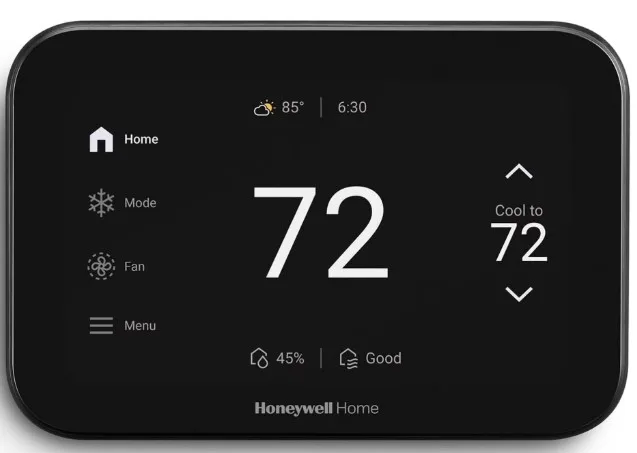
For buyers who want to further maximize performance, EGS offers two 97% efficiency options – a two-stage furnace and a two-stage air conditioning unit with a programmable WIFI enabled smart thermostat.
What are the Advantages of a Two-Stage Furnace System?
- In mild weather, the system runs on low – using less energy, continuously circulating air, and eliminating the hot and cold spots that are quite common in older homes
- On the coldest or hottest days, the high stage kicks in automatically
- The variable-speed blower motor adjusts to what the home actually needs, not a fixed output
- The Honeywell thermostat adds Wi-Fi connectivity and programmable modes which are great for on-the-go households, and it also offers more precise fan-speed control
It’s important to note that even the most efficient furnace can’t fully compensate for a poorly sealed building envelope.
But when the home’s envelope is tight and the walls, foundation, and air sealing are all doing their job, the HVAC system doesn’t have to work as hard. So it runs less and lasts longer. And your utility bill will reflect that.
Understanding the HERS Score
Every feature that goes into an EGStoltzfus home – foundation, wall assembly, HVAC system – adds up to a number that can be independently measured.
The Home Energy Rating System, or HERS, is an independent rating system that quantifies how a home performs, and it’s one of the most useful tools a homebuyer can use when comparing a new construction home to a resale home.
On the HERS scale, 100 represents a standard new home built to the 2006 energy code, and zero represents a net-zero energy home. The lower the score, the more energy efficient the home is.
EGStoltzfus homes average a HERS score of 59. That means our homes are approximately 41% more energy efficient than the baseline standard new home.
That places an EGS home well beyond typical code-minimum construction and solidly in the high-performance category.
Many resale homes have never been HERS-rated but it’s considered that many would score well above 100.
What are the Benefits of a Low HERS Score?
While energy savings is the main takeaway, there are other benefits to having a home with a well-built envelope and low HERS score:
- More consistent temps and indoor comfort throughout the home
- Fewer hot and cold spots between floors
- Better indoor air quality
- Reduced environmental impact
- Long-term value that holds
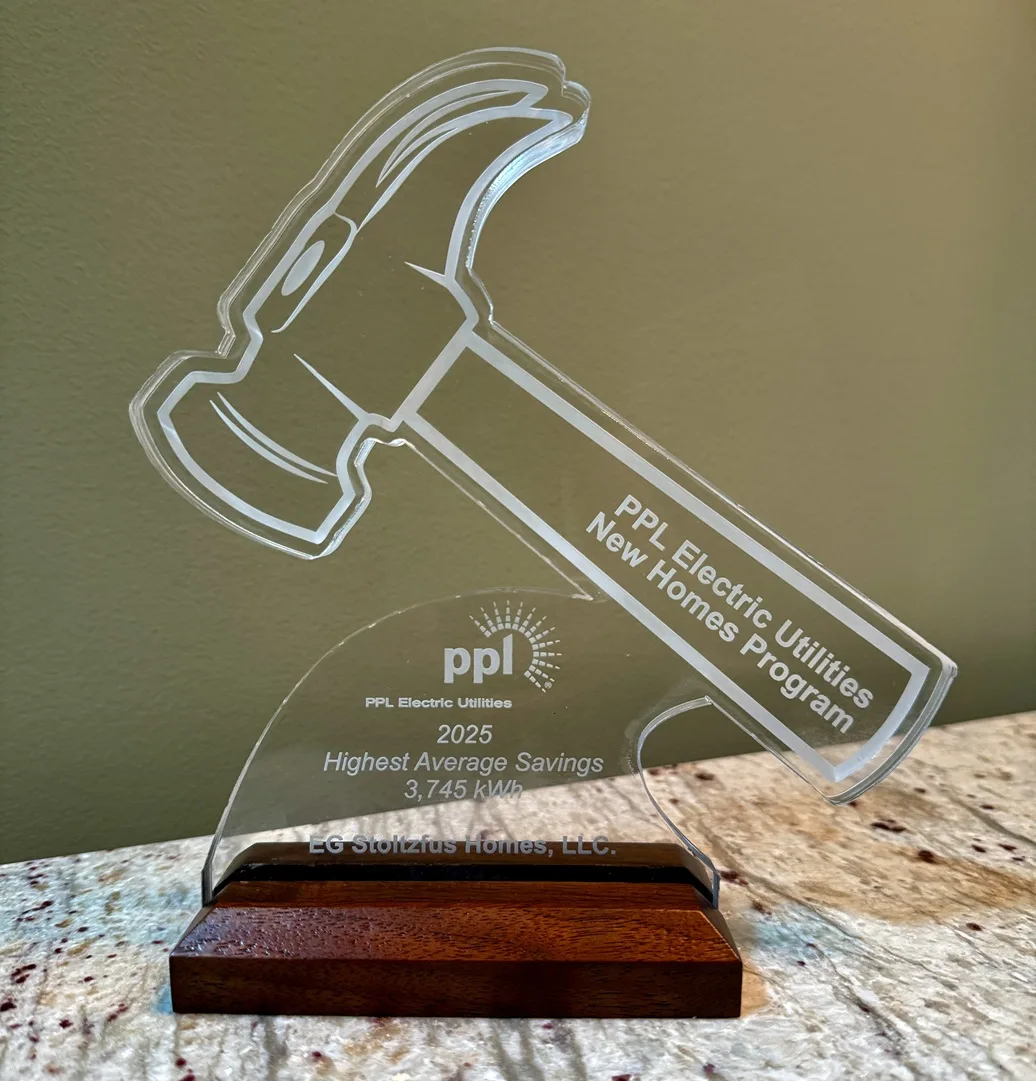
In November of 2025, EGStoltzfus was recognized with an award from PPL for highest average energy savings per home. PPL is the regional electric utility that serves central and eastern Pennsylvania.
EGS was recognized with saving customers an average of 3,745 kWh annually; that translates to approximately $468 in electricity cost savings every year.
If you compound that savings over a 10-year period, that’s more than $4,600 before accounting for any rate increases.
Since most EGStoltzfus homes are heated with natural gas, the bulk of those electric savings are realized during the cooling months when a well-sealed envelope and a high-efficiency air conditioning system work together to keep the home comfortable without overworking the equipment.
That’s why envelope performance matters just as much in July as it does in January.
It’s also worth noting that EGStoltzfus homes include a high-efficiency water heater as part of the standard build – another ongoing energy cost that tends to get overlooked in the new-vs-resale comparison, but adds up over time.
Resale Homes: Look Beyond the Purchase Price
A new EGStoltzfus home may carry a higher upfront price when compared to a resale home. But the purchase price is a one-time number.
Energy usage, maintenance, repair cycles, and system upgrades are ongoing after you buy a home.
But in a new construction home built by EGStoltzfus, these costs are measurably lower.
Once you factor in lower monthly utility costs, fewer repairs, and verified HERS performance, the math on new construction vs. a resale home starts to look very different.
Tour an Energy-Efficient EGS Model Home
Plan a visit to an EGStoltzfus model home and learn about our other energy-efficient construction features, HERS scores, and HVAC upgrade options.
And remember that all of our neighborhoods across Lancaster, York, Harrisburg, and Mechanicsburg are built with comfort, performance, and value as the standard!
Frequently Asked Questions
Q: Are new construction homes really more energy efficient than resale homes?
Yes. New construction homes are built to current energy codes and, in many cases, exceed them. EGStoltzfus homes average a HERS score of 59, meaning they perform approximately 41% better than the 2006 baseline standard new home. Most resale homes have not been energy tested and may score well above 100 on the same scale.
Q: What is a HERS score and why does it matter when buying a new home?
A HERS (Home Energy Rating System) score is an independent, third-party measurement of a home’s energy performance. The lower the score, the more efficient the home. A score of 100 represents a standard new home built to the 2006 energy code; 0 represents a net-zero energy home. Through independent verification, EGStoltzfus homes average 59.
Q: What makes EGStoltzfus homes more energy efficient than other new homes in central PA?
EGStoltzfus builds with a combination of features that work as a system: Superior Walls precast concrete foundations with built-in insulation, a 2×4 wall assembly spaced at 16” with R-5 continuous exterior insulation (which outperforms traditional 2×6 R-19 batt walls in real-world conditions), blown R-49 attic insulation, and a 96% efficient Carrier gas furnace that is standard in every home. Optional upgrades include a 97% efficiency two-stage furnace and two-stage AC unit. EGStoltzfus was also recognized by PPL for highest average energy savings per home – an average of 3,745 kWh annually, or approximately $468 in electricity savings per year.
Q: What are the hidden costs of buying a resale home vs. new construction?
Resale homes carry energy costs that don’t appear on the listing price. Older wall assemblies, unverified insulation, aging HVAC systems, and foundations without continuous insulation contribute to higher monthly utility bills and more frequent maintenance. These are ongoing costs that compound over years; and unlike the purchase price they don’t go away.
Q: What is continous exterior insulation and why is it better than standard batt insulation?
Continuous exterior insulation is installed on all exterior thermo-envelope framed walls to create an unbroken thermal barrier. Standard batt insulation is installed between studs but doesn’t cover the studs themselves, which allows heat to transfer through the framing (called thermal bridging). EGStoltzfus homes use a 2×4 wall system spaced at 16” with R-13 insulation plus R-5 continuous exterior insulation, which eliminates thermal bridging and delivers better real-world energy performance than a traditional 2×6 R-19 batt wall.
Q: What is a two-stage furance and is it worth the upgrade?
A two-stage furnace operates at two output levels – low and high – rather than simply on or off. In mild weather, it runs on low, using less energy and continuously circulating air to eliminate hot and cold spots. On the coldest days, it automatically shifts to high for maximum output. Paired with a variable-speed blower motor and a smart thermostat, a two-stage furnace delivers more consistent comfort and lower energy costs compared to a single-stage system. For many homebuyers, it’s worth the upgrade.